Skip to content
EDIVRO

News built for discoveryGEO · AEO · Agentic search

What is Edivro?Sign inSubmit news / Build profile
News

Explore Edivro

The business of what’s next.

News, company developments and ideas from across the Edivro publishing network.

Explore all stories

The front page

  • Latest storiesThe complete publication bank
  • Company news
  • Latest insights
  • Leadership news

Discover more

  • AI & innovation
  • People & profiles
  • Company features
  • Explore all topics
Stories. Connected.

Explore the Edivro story bank.

Explore all stories →
Explore the story bank →
What is Edivro?Editorial standards
Companies

Explore Edivro

Inside the businesses.

Company stories, brand profiles and announcements, with original dates and source attribution.

Explore company news

Companies & brands

  • Company news
  • Company features
  • Brand stories
  • Brand strategy

Explore business

  • Industry coverage
  • Leadership profiles
  • Business insights
  • Browse by location
Stories. Connected.

Explore the Edivro story bank.

Explore company news →
Explore the story bank →
What is Edivro?Editorial standards
Leaders & Profiles

Explore Edivro

The people behind the story.

Meet founders, executives and professionals through their work and published profiles.

Explore leader profiles

People to know

  • Featured leaders
  • Leadership stories
  • Young entrepreneurs
  • Newsmakers

Ideas & work

  • Leadership news
  • Workplace & culture
  • Company stories
  • Browse public profilesPeople behind the coverage
Stories. Connected.

Explore the Edivro story bank.

Explore leader profiles →
Explore the story bank →
What is Edivro?Editorial standards
Industries

Explore Edivro

A wider view of business.

Follow developments across sectors, from artificial intelligence to healthcare and real estate.

Explore all industries

Industry coverage

  • Artificial intelligence
  • Business
  • Real estate
  • Healthcare

More sectors

  • Manufacturing
  • Education
  • Fintech
  • All sectors & topics
Stories. Connected.

Explore the Edivro story bank.

Explore all industries →
Explore the story bank →
What is Edivro?Editorial standards
AI & Tech

Explore Edivro

Ideas changing the way we work.

Artificial intelligence, enterprise technology and the businesses building what comes next.

Explore AI coverage

AI & technology

  • Artificial intelligence
  • Technology stories
  • Enterprise AI & SaaS
  • Fintech & payments

News & insight

  • AI news
  • Industry insights
  • Company announcements
  • Research & ideas
Stories. Connected.

Explore the Edivro story bank.

Explore AI coverage →
Explore the story bank →
What is Edivro?Editorial standards
Press Room

Explore Edivro

Announcements. In context.

Find business announcements, company news and clearly labelled press releases.

Explore the Press Room

Read announcements

  • Company news & releasesAnnouncements from named issuers
  • Company news
  • Latest published stories
  • Browse industries

News by subject

  • Funding & investment
  • Appointments
  • Products & launches
  • Partnerships
Stories. Connected.

Explore the Edivro story bank.

Explore the Press Room →
Explore the story bank →
What is Edivro?Editorial standards
Work with Edivro

Create on Edivro

Choose how you work with Edivro.

Publishing for individuals and companies, client orders for agencies, and wider communications programmes for businesses.

Explore the three routes

Who you are

  • Individuals and companiesProfiles, stories and press releases
  • AgenciesPublishing for authorised clients
  • Corporate and businessPR, content, discovery and campaigns
  • Services & pricingCurrent per-article prices

Publishing tools

  • Build your profile
  • Submit your news
  • Edivro AI
  • How publishing works
Your next story.

Work with Edivro

Choose the route that fits your work.

Explore services
Explore the story bank →
What is Edivro?Editorial standards
Latest storiesCompany newsLeader profilesArtificial intelligence

Explore Edivro

News, companies and the people behind them.

News

Explore Edivro

The business of what’s next.

News, company developments and ideas from across the Edivro publishing network.

Explore all stories

The front page

  • Latest storiesThe complete publication bank
  • Company news
  • Latest insights
  • Leadership news

Discover more

  • AI & innovation
  • People & profiles
  • Company features
  • Explore all topics
Stories. Connected.

Explore the Edivro story bank.

Explore all stories →
Explore the story bank →
What is Edivro?Editorial standards
Companies

Explore Edivro

Inside the businesses.

Company stories, brand profiles and announcements, with original dates and source attribution.

Explore company news

Companies & brands

  • Company news
  • Company features
  • Brand stories
  • Brand strategy

Explore business

  • Industry coverage
  • Leadership profiles
  • Business insights
  • Browse by location
Stories. Connected.

Explore the Edivro story bank.

Explore company news →
Explore the story bank →
What is Edivro?Editorial standards
Leaders & Profiles

Explore Edivro

The people behind the story.

Meet founders, executives and professionals through their work and published profiles.

Explore leader profiles

People to know

  • Featured leaders
  • Leadership stories
  • Young entrepreneurs
  • Newsmakers

Ideas & work

  • Leadership news
  • Workplace & culture
  • Company stories
  • Browse public profilesPeople behind the coverage
Stories. Connected.

Explore the Edivro story bank.

Explore leader profiles →
Explore the story bank →
What is Edivro?Editorial standards
Industries

Explore Edivro

A wider view of business.

Follow developments across sectors, from artificial intelligence to healthcare and real estate.

Explore all industries

Industry coverage

  • Artificial intelligence
  • Business
  • Real estate
  • Healthcare

More sectors

  • Manufacturing
  • Education
  • Fintech
  • All sectors & topics
Stories. Connected.

Explore the Edivro story bank.

Explore all industries →
Explore the story bank →
What is Edivro?Editorial standards
AI & Tech

Explore Edivro

Ideas changing the way we work.

Artificial intelligence, enterprise technology and the businesses building what comes next.

Explore AI coverage

AI & technology

  • Artificial intelligence
  • Technology stories
  • Enterprise AI & SaaS
  • Fintech & payments

News & insight

  • AI news
  • Industry insights
  • Company announcements
  • Research & ideas
Stories. Connected.

Explore the Edivro story bank.

Explore AI coverage →
Explore the story bank →
What is Edivro?Editorial standards
Press Room

Explore Edivro

Announcements. In context.

Find business announcements, company news and clearly labelled press releases.

Explore the Press Room

Read announcements

  • Company news & releasesAnnouncements from named issuers
  • Company news
  • Latest published stories
  • Browse industries

News by subject

  • Funding & investment
  • Appointments
  • Products & launches
  • Partnerships
Stories. Connected.

Explore the Edivro story bank.

Explore the Press Room →
Explore the story bank →
What is Edivro?Editorial standards
Work with Edivro

Create on Edivro

Choose how you work with Edivro.

Publishing for individuals and companies, client orders for agencies, and wider communications programmes for businesses.

Explore the three routes

Who you are

  • Individuals and companiesProfiles, stories and press releases
  • AgenciesPublishing for authorised clients
  • Corporate and businessPR, content, discovery and campaigns
  • Services & pricingCurrent per-article prices

Publishing tools

  • Build your profile
  • Submit your news
  • Edivro AI
  • How publishing works
Your next story.

Work with Edivro

Choose the route that fits your work.

Explore services
Explore the story bank →
What is Edivro?Editorial standards

Your publishing workspace

Build a profile. Prepare your story. Manage orders and billing.

Sign in / create account
What is Edivro?How it worksServices & pricing

Search Edivro

Browse full results →
  1. EDIVRO/
  2. Stories
EDIVRO News ProfileClean energy and utilities

What this year's Nobel prizes teach about long bets and open sharing

Optogenetics, IceCube and asymmetric synthesis won 2026 Nobels after decades of work. What corporate R&D leaders can learn about patience and sharing.
By WCRC Leaders
Global · 16 Oct 2026 · 5 min read

EDIVRO News Profile feature

Share story ↓
Add as a Preferred Source on GoogleFind Edivro on Google News
What this year's Nobel prizes teach about long bets and open sharing
EDIVROStory photograph

Pulled from WCRC Leaders. Original publication date and full article text retained. Source category: Latest Insights.

At a glance

  • At a glance: Between 5 and 7 October 2026, the Nobel Prizes in medicine, physics and chemistry went to work that took decades to pay off.
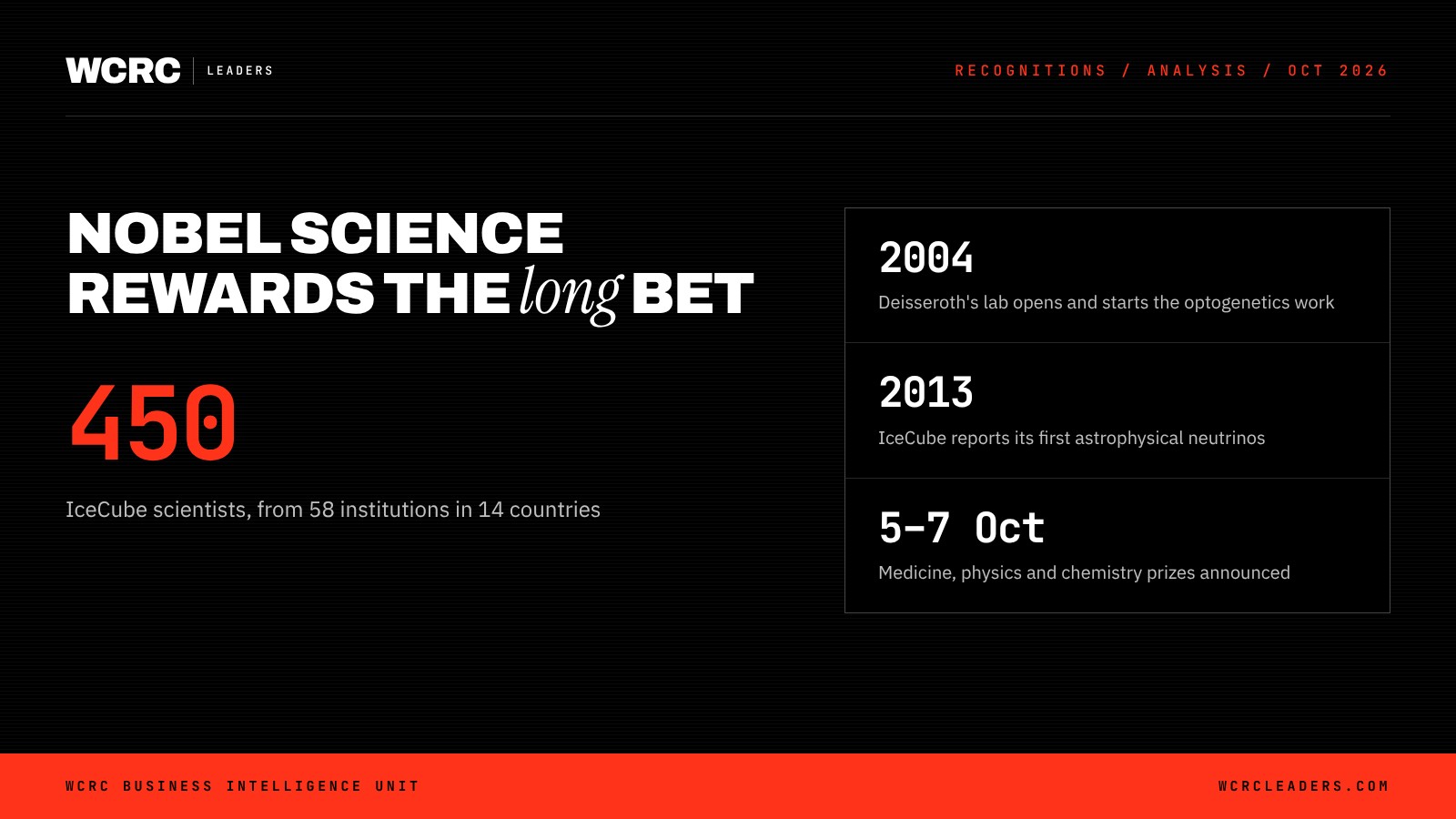
  • The timeline is instructive. Deisseroth's lab opened in July 2004, when he and two graduate students began the project. A 2005 paper described an engineered opsin that fires neurons under blue light.

At a glance: Between 5 and 7 October 2026, the Nobel Prizes in medicine, physics and chemistry went to work that took decades to pay off. Karl Deisseroth, Peter Hegemann and Georg Nagel were honoured for discoveries leading to optogenetics; Francis Halzen for the IceCube Neutrino Observatory; Henri Kagan and Kenso Soai for advances in asymmetric synthesis. For companies, the prizes are a case study in patient research and the value of sharing tools openly.

Medicine: a tool that spread because it was shared

On 5 October, the Nobel Prize in Physiology or Medicine went to Karl Deisseroth of Stanford University, Peter Hegemann of Humboldt University of Berlin and Georg Nagel of the University of Würzburg, for discoveries leading to optogenetics.

Optogenetics uses light to switch individual nerve cells in a living brain on or off. Deisseroth's approach inserts light-sensitive proteins from microbes, called opsins, into mammalian brain cells. Shine the right light, and the cell fires or falls silent. Deisseroth explains it to children more simply: "We're poking the brain."

The timeline is instructive. Deisseroth's lab opened in July 2004, when he and two graduate students began the project. A 2005 paper described an engineered opsin that fires neurons under blue light. More than two decades later, the work has won a Nobel.

What made optogenetics spread was not only the science. According to Stanford Medicine, Deisseroth freely shared reagents, protocols and knowledge with as many scientists as possible. His lab distributed copies of the engineered opsin gene to laboratories around the world, and his Stanford programme has trained thousands of scientists in the technique. A tool that could have stayed in one lab became a standard method across neuroscience.

Physics: a forty-year bet under the South Pole

On 6 October, the Nobel Prize in Physics went to Francis Halzen, 82, of the University of Wisconsin–Madison, for decisive contributions to the IceCube Neutrino Observatory and the discovery of high-energy neutrinos of astrophysical origin.

Neutrinos are tiny particles produced by some of the most energetic events in the universe. They are extremely hard to catch. Halzen, who joined the Wisconsin physics faculty in 1972, began working on the idea of detecting them in Antarctic ice in the 1980s, and proposed and demonstrated that ice could serve as the detector. He oversaw the design and development of IceCube and its predecessor, AMANDA.

The result is a detector covering about one cubic kilometre of glacial ice at the South Pole. It is funded and operated mainly by the US National Science Foundation through the University of Wisconsin–Madison, and the collaboration now involves about 450 scientists from 58 institutions in 14 countries. The first astrophysical neutrinos were reported in 2013. In 2023 IceCube reported neutrinos from our own galaxy, the Milky Way.

Mark Pearce, chair of the Nobel Committee for Physics, said Halzen "has led an international team of researchers and engineers who have provided us with a fantastic instrument". Halzen called the prize "a celebration of a very unusual project" and said: "It's a great relief for me to finally deliver the recognition that this great collaboration deserves."

Chemistry: solving an old puzzle about mirror images

On 7 October, the Nobel Prize in Chemistry went to French chemist Henri Kagan and Kenso Soai, professor emeritus at Tokyo University of Science, for their discoveries of non-linear effects and autocatalysis in asymmetric organic synthesis.

Many molecules come in two mirror-image forms, like left and right hands. In medicines, flavours and materials, one form can behave very differently from the other. Kagan showed that reactions could be steered to produce one form in far greater excess than previously thought possible. Soai designed a reaction, now known as the Soai reaction, that produces only one of the possible mirror-image forms. Heiner Linke, chair of the Nobel Committee for Chemistry, said the two had "provided a solution to a chemical mystery that is over a century old".

Soai, born in 1950, made the discovery during his career at Tokyo University of Science. His first words of thanks went to his team: "I was able to reach this point thanks to the students."

Analysis: three lessons for corporate R&D

The following is WCRC Leaders' interpretation, not a finding from the Nobel committees.

Long horizons still pay. Optogenetics took about two decades from first experiment to Nobel. IceCube took roughly three decades from idea to first discovery. Most corporate R&D portfolios are judged on far shorter cycles. The prizes do not argue that every bet should run for 30 years, but they suggest that a portfolio with no long bets at all may miss the discoveries that later define a field.

Sharing can multiply value. Deisseroth's open distribution of tools turned a lab method into an industry standard. In business terms, giving away the platform built the market. Companies that share research tools, data formats or standards, while protecting what truly differentiates them, can grow the ecosystem their own products depend on.

Big science is team science. IceCube is a collaboration of hundreds of scientists across many countries, and both Halzen and Soai credited their teams first. Corporate R&D increasingly relies on partnerships with universities, suppliers and even competitors. Governance, credit-sharing and long-term funding commitments are part of the research strategy, not an administrative afterthought.

What it means for leaders

  • Ring-fence a share of R&D for long-horizon projects with milestones measured in learning, not quarterly revenue.
  • Decide deliberately what to share: research tools and standards can grow your market, while core know-how stays protected.
  • Build university and consortium partnerships with funding horizons that match the science.
  • Recognise and credit research teams publicly; talent follows organisations that do.
  • Review how your R&D governance would treat a project like IceCube: would it have survived its first ten years?

Quick answers

Q: Who won the 2026 Nobel Prize in Physiology or Medicine? A: Karl Deisseroth, Peter Hegemann and Georg Nagel, for discoveries leading to optogenetics, a method that uses light to switch nerve cells on or off.

Q: Who won the 2026 Nobel Prize in Physics? A: Francis Halzen of the University of Wisconsin–Madison, for decisive contributions to the IceCube Neutrino Observatory and the discovery of high-energy neutrinos of astrophysical origin.

Q: Who won the 2026 Nobel Prize in Chemistry? A: Henri Kagan and Kenso Soai, for discoveries of non-linear effects and autocatalysis in asymmetric organic synthesis, which concerns how one mirror-image form of a molecule can be made to dominate.

Questions about this story

These answers summarise the article and refer to its original reporting period.

What does the article report about “Medicine: a tool that spread because it was shared”?

The timeline is instructive. Deisseroth's lab opened in July 2004, when he and two graduate students began the project. A 2005 paper described an engineered opsin that fires neurons under blue light. More than two decades later, the work has won a Nobel.

What does the article report about “Physics: a forty-year bet under the South Pole”?

Neutrinos are tiny particles produced by some of the most energetic events in the universe. They are extremely hard to catch. Halzen, who joined the Wisconsin physics faculty in 1972, began working on the idea of detecting them in Antarctic ice in the 1980s, and proposed and demonstrated that ice could serve as the detector. He oversaw the design and development of IceCube and its predecessor, AMANDA.

What does the article report about “Chemistry: solving an old puzzle about mirror images”?

Soai, born in 1950, made the discovery during his career at Tokyo University of Science. His first words of thanks went to his team: "I was able to reach this point thanks to the students."

Request a correctionEditorial standards
NewsLatest InsightsSource WcrcleadersGlobal

Author

WCRC Leaders

Share this story

LinkedInFacebookXWhatsAppTelegramRedditPinterestThreadsBlueskyEmail

Clean energy and utilities

Related stories

Enerwhere: Reinventing Off-Grid Power for a Lower-Carbon Middle East — Edivro editorial illustrationEDIVROEditorial illustration
EDIVRO News Profile

brand story

Enerwhere: Reinventing Off-Grid Power for a Lower-Carbon Middle East

From desert construction sites and quarries to islands, industrial facilities and oilfield operations, Enerwhere has built its reputation by taking renewable energy where conventional grids often cannot go — combining solar, storage, intelligent controls and flexible power systems to reduce diesel dependence without sacrificing reliability.

7 Sept 2026

EDIVRO News Profile feature from the imported archive. Original publication dates retained.

Singapore's core inflation cools to 2.0% as India and Japan heat up — Edivro editorial illustrationEDIVROEditorial illustration
EDIVRO News Profile

story

Singapore's core inflation cools to 2.0% as India and Japan heat up

Singapore's core inflation eased to 2.0% in September as India's CPI hit 5.54% and Japan's core-core rose to 2.4%. What CEOs should do on pricing.

26 Oct 2026

Pulled from WCRC Leaders. Original publication date retained.

India's core sector grows 7.9% in September despite the oil shock — Edivro editorial illustrationEDIVROEditorial illustration
EDIVRO News Profile

story

India's core sector grows 7.9% in September despite the oil shock

India's core industries grew 7.9% in September 2026, led by iron ore, power and coal. What it signals for Q2 GDP, capex and Gulf and Asian suppliers.

23 Oct 2026

Pulled from WCRC Leaders. Original publication date retained.

Original publication dates and source disclosures are retained. New submissions are reviewed before publication.

EDIVRO

Edivro publishes business news, company and leadership profiles, and industry analysis. Our publishing approach combines SEO, GEO and AEO with clear headlines, named sources and useful answers for readers and AI research agents.

Explore publishing on Edivro
Add as a Preferred Source on GoogleFind Edivro on Google News

About Edivro

  • About us
  • How it works
  • Editorial standards
  • Corrections & contact

Publish with Edivro

  • For creators
  • For agencies
  • For businesses
  • Pricing

Learn about discovery

  • Publishing for search and AI
  • SEO vs GEO vs AEO
  • Agentic search
  • Company announcements
  • Search discovery
  • Measure AI visibility

Explore Edivro

  • Latest stories
  • Industries
  • Company profiles
  • Leadership profiles
  • Press Room

© 2026 EDIVRO. All rights reserved.

Sign in / My StudioTerms & refundsPrivacySubscribe via RSS

Press releases are submitted content and are labelled as such.