Skip to content
EDIVRO

News built for discoveryGEO · AEO · Agentic search

What is Edivro?Sign inSubmit news / Build profile
News

Explore Edivro

The business of what’s next.

News, company developments and ideas from across the Edivro publishing network.

Explore all stories

The front page

  • Latest storiesThe complete publication bank
  • Company news
  • Latest insights
  • Leadership news

Discover more

  • AI & innovation
  • People & profiles
  • Company features
  • Explore all topics
Stories. Connected.

Explore the Edivro story bank.

Explore all stories →
Explore the story bank →
What is Edivro?Editorial standards
Companies

Explore Edivro

Inside the businesses.

Company stories, brand profiles and announcements, with original dates and source attribution.

Explore company news

Companies & brands

  • Company news
  • Company features
  • Brand stories
  • Brand strategy

Explore business

  • Industry coverage
  • Leadership profiles
  • Business insights
  • Browse by location
Stories. Connected.

Explore the Edivro story bank.

Explore company news →
Explore the story bank →
What is Edivro?Editorial standards
Leaders & Profiles

Explore Edivro

The people behind the story.

Meet founders, executives and professionals through their work and published profiles.

Explore leader profiles

People to know

  • Featured leaders
  • Leadership stories
  • Young entrepreneurs
  • Newsmakers

Ideas & work

  • Leadership news
  • Workplace & culture
  • Company stories
  • Browse public profilesPeople behind the coverage
Stories. Connected.

Explore the Edivro story bank.

Explore leader profiles →
Explore the story bank →
What is Edivro?Editorial standards
Industries

Explore Edivro

A wider view of business.

Follow developments across sectors, from artificial intelligence to healthcare and real estate.

Explore all industries

Industry coverage

  • Artificial intelligence
  • Business
  • Real estate
  • Healthcare

More sectors

  • Manufacturing
  • Education
  • Fintech
  • All sectors & topics
Stories. Connected.

Explore the Edivro story bank.

Explore all industries →
Explore the story bank →
What is Edivro?Editorial standards
AI & Tech

Explore Edivro

Ideas changing the way we work.

Artificial intelligence, enterprise technology and the businesses building what comes next.

Explore AI coverage

AI & technology

  • Artificial intelligence
  • Technology stories
  • Enterprise AI & SaaS
  • Fintech & payments

News & insight

  • AI news
  • Industry insights
  • Company announcements
  • Research & ideas
Stories. Connected.

Explore the Edivro story bank.

Explore AI coverage →
Explore the story bank →
What is Edivro?Editorial standards
Press Room

Explore Edivro

Announcements. In context.

Find business announcements, company news and clearly labelled press releases.

Explore the Press Room

Read announcements

  • Company news & releasesAnnouncements from named issuers
  • Company news
  • Latest published stories
  • Browse industries

News by subject

  • Funding & investment
  • Appointments
  • Products & launches
  • Partnerships
Stories. Connected.

Explore the Edivro story bank.

Explore the Press Room →
Explore the story bank →
What is Edivro?Editorial standards
Work with Edivro

Create on Edivro

Choose how you work with Edivro.

Publishing for individuals and companies, client orders for agencies, and wider communications programmes for businesses.

Explore the three routes

Who you are

  • Individuals and companiesProfiles, stories and press releases
  • AgenciesPublishing for authorised clients
  • Corporate and businessPR, content, discovery and campaigns
  • Services & pricingCurrent per-article prices

Publishing tools

  • Build your profile
  • Submit your news
  • Edivro AI
  • How publishing works
Your next story.

Work with Edivro

Choose the route that fits your work.

Explore services
Explore the story bank →
What is Edivro?Editorial standards
Latest storiesCompany newsLeader profilesArtificial intelligence

Explore Edivro

News, companies and the people behind them.

News

Explore Edivro

The business of what’s next.

News, company developments and ideas from across the Edivro publishing network.

Explore all stories

The front page

  • Latest storiesThe complete publication bank
  • Company news
  • Latest insights
  • Leadership news

Discover more

  • AI & innovation
  • People & profiles
  • Company features
  • Explore all topics
Stories. Connected.

Explore the Edivro story bank.

Explore all stories →
Explore the story bank →
What is Edivro?Editorial standards
Companies

Explore Edivro

Inside the businesses.

Company stories, brand profiles and announcements, with original dates and source attribution.

Explore company news

Companies & brands

  • Company news
  • Company features
  • Brand stories
  • Brand strategy

Explore business

  • Industry coverage
  • Leadership profiles
  • Business insights
  • Browse by location
Stories. Connected.

Explore the Edivro story bank.

Explore company news →
Explore the story bank →
What is Edivro?Editorial standards
Leaders & Profiles

Explore Edivro

The people behind the story.

Meet founders, executives and professionals through their work and published profiles.

Explore leader profiles

People to know

  • Featured leaders
  • Leadership stories
  • Young entrepreneurs
  • Newsmakers

Ideas & work

  • Leadership news
  • Workplace & culture
  • Company stories
  • Browse public profilesPeople behind the coverage
Stories. Connected.

Explore the Edivro story bank.

Explore leader profiles →
Explore the story bank →
What is Edivro?Editorial standards
Industries

Explore Edivro

A wider view of business.

Follow developments across sectors, from artificial intelligence to healthcare and real estate.

Explore all industries

Industry coverage

  • Artificial intelligence
  • Business
  • Real estate
  • Healthcare

More sectors

  • Manufacturing
  • Education
  • Fintech
  • All sectors & topics
Stories. Connected.

Explore the Edivro story bank.

Explore all industries →
Explore the story bank →
What is Edivro?Editorial standards
AI & Tech

Explore Edivro

Ideas changing the way we work.

Artificial intelligence, enterprise technology and the businesses building what comes next.

Explore AI coverage

AI & technology

  • Artificial intelligence
  • Technology stories
  • Enterprise AI & SaaS
  • Fintech & payments

News & insight

  • AI news
  • Industry insights
  • Company announcements
  • Research & ideas
Stories. Connected.

Explore the Edivro story bank.

Explore AI coverage →
Explore the story bank →
What is Edivro?Editorial standards
Press Room

Explore Edivro

Announcements. In context.

Find business announcements, company news and clearly labelled press releases.

Explore the Press Room

Read announcements

  • Company news & releasesAnnouncements from named issuers
  • Company news
  • Latest published stories
  • Browse industries

News by subject

  • Funding & investment
  • Appointments
  • Products & launches
  • Partnerships
Stories. Connected.

Explore the Edivro story bank.

Explore the Press Room →
Explore the story bank →
What is Edivro?Editorial standards
Work with Edivro

Create on Edivro

Choose how you work with Edivro.

Publishing for individuals and companies, client orders for agencies, and wider communications programmes for businesses.

Explore the three routes

Who you are

  • Individuals and companiesProfiles, stories and press releases
  • AgenciesPublishing for authorised clients
  • Corporate and businessPR, content, discovery and campaigns
  • Services & pricingCurrent per-article prices

Publishing tools

  • Build your profile
  • Submit your news
  • Edivro AI
  • How publishing works
Your next story.

Work with Edivro

Choose the route that fits your work.

Explore services
Explore the story bank →
What is Edivro?Editorial standards

Your publishing workspace

Build a profile. Prepare your story. Manage orders and billing.

Sign in / create account
What is Edivro?How it worksServices & pricing

Search Edivro

Browse full results →
  1. EDIVRO/
  2. Stories
EDIVRO News ProfileBusiness

The UK's employment-law reset is live: a checklist for leaders

Tribunal time limits doubled on 1 October and new harassment and union duties start on 30 October 2026. What UK managers and HR must change now.
By WCRC Leaders
Global · 16 Oct 2026 · 5 min read

EDIVRO News Profile feature

Share story ↓
Add as a Preferred Source on GoogleFind Edivro on Google News
The UK's employment-law reset is live: a checklist for leaders
EDIVROStory photograph

Pulled from WCRC Leaders. Original publication date and full article text retained. Source category: Latest Insights.

At a glance

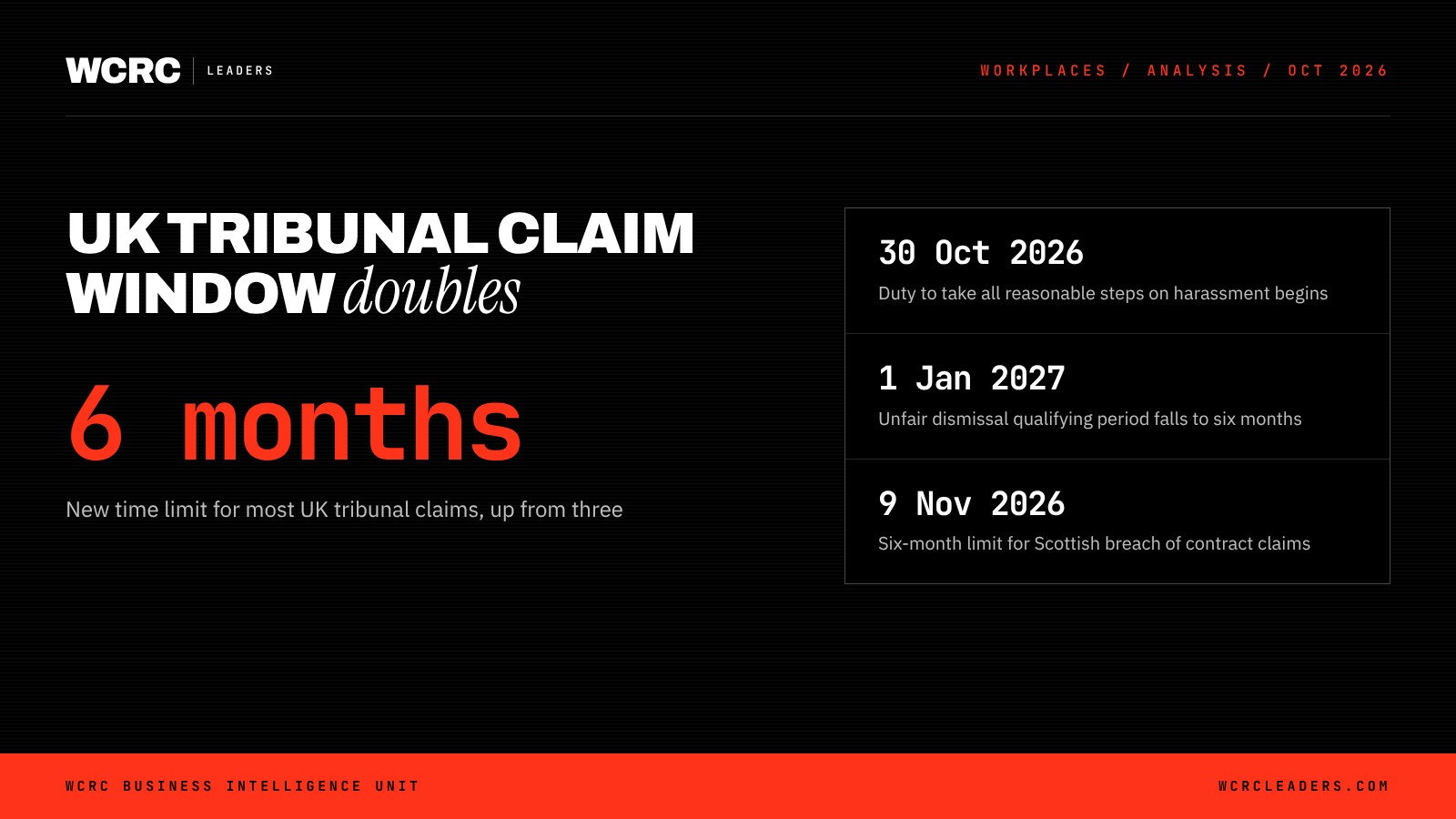
  • At a glance: Under the Employment Rights Act 2025, the time limit for most UK employment tribunal claims doubled from three to six months on 1 October 2026.
  • The Employment Rights Act 2025, which received Royal Assent in December 2025, is being phased in through 2026 and 2027.

At a glance: Under the Employment Rights Act 2025, the time limit for most UK employment tribunal claims doubled from three to six months on 1 October 2026. From 30 October 2026, employers must take "all reasonable steps" to prevent sexual harassment, must not permit harassment of staff by third parties, and face stronger trade union access rights. From January 2027 the unfair dismissal qualifying period falls to six months. Leaders have weeks, not months, to prepare.

What has already changed

The Employment Rights Act 2025, which received Royal Assent in December 2025, is being phased in through 2026 and 2027. Its most recent milestone arrived on 1 October 2026, when the standard time limit for bringing most employment tribunal claims, including unfair dismissal and discrimination, rose from three months to six.

Government guidance indicates that the three-month limit may still apply to matters that arose before 1 October. For breach of contract claims in Scotland, the six-month limit starts on 9 November 2026. Claimants must still notify Acas, the workplace conciliation service, before lodging a claim.

WCRC analysis: the practical effect is that employers will live with uncertainty for longer after a dismissal, a grievance outcome or a disputed decision. Evidence that might once have been discarded after a few months now needs to be kept and kept in order. Internal processes such as grievances and appeals do not pause the statutory clock, so a long internal process does not protect the employer.

What starts on 30 October

The Department for Business and Trade's implementation timeline, last updated on 14 October 2026, confirms two groups of measures that take effect on 30 October.

Harassment. Employers already have a duty to take reasonable steps to prevent sexual harassment of their employees. From 30 October that becomes a duty to take "all reasonable steps". Employers will also be under a duty not to permit harassment of their employees by third parties, such as customers, clients and contractors, and can be liable unless they took all reasonable steps to prevent it. Ministers have a power to set out in later regulations specific steps that count as reasonable, which will supplement rather than replace the duty.

Trade unions. A stronger statutory right for unions to access workplaces takes effect, along with reforms to the recognition and derecognition process, including freezing the bargaining unit once an application is made. There are new rights and protections for union representatives, including facilities and time off for some roles, and extended protection against detriment for workers who take part in industrial action.

What comes next

The timeline sets out further changes that leaders should plan for now.

  • January 2027: the qualifying period for ordinary unfair dismissal falls from two years to six months for dismissals from 1 January 2027, and the cap on compensatory awards is removed. Employers must also inform workers of their right to join a union, and new protections against "fire and rehire" take effect.
  • During 2027: measures expected include mandatory gender equality and menopause action plans for larger employers, changes to flexible working, a right to guaranteed hours and reasonable notice of shifts for low-hours workers, enhanced dismissal protection for pregnant women and new mothers, new rules voiding non-disclosure agreements that prevent reporting of harassment or discrimination, and a change to how collective redundancy thresholds are calculated.

The government notes that all future dates remain subject to parliamentary processes and may change.

The leader's checklist

WCRC analysis: the following steps are practical priorities based on the published timeline. They are not legal advice, and specific situations should be reviewed with employment counsel.

1. Extend your evidence window. Review document retention so that records of investigations, performance meetings, adjustments, grievance outcomes and dismissal decisions are kept for at least the full claims period plus Acas conciliation time.

2. Reset your harassment prevention plan before 30 October. Carry out or refresh a risk assessment covering employees, customers, clients and contractors. Update policies, reporting routes and training. Record what you have done and why, because the test is now "all reasonable steps".

3. Address third-party risk. Identify roles with high exposure to the public or clients, such as hospitality, retail, healthcare, events and client-facing professional services. Set clear rules for customer conduct and empower staff and managers to act.

4. Prepare for union access requests. Nominate a point of contact, agree how access requests will be assessed and brief site managers so that their first response is consistent and lawful.

5. Review probation and dismissal practice before January. With the unfair dismissal qualifying period dropping to six months, probation periods, performance management and early-tenure dismissals need fair process and good records.

6. Train line managers. Most claims start with a manager's decision. Managers need to recognise when an everyday decision carries legal risk and when to involve HR.

7. Budget for the change. Uncapped compensatory awards from January raise the potential cost of a poor dismissal. Finance teams should understand the shift.

What it means for leaders

  • Treat 30 October 2026 as a hard deadline for refreshed harassment risk assessments, policies and training.
  • Extend document retention to cover the six-month claim window plus conciliation.
  • Brief site managers on new union access rights before the first request arrives.
  • Review probation and early-tenure dismissal processes ahead of January 2027.
  • Assign an executive owner for the remaining Employment Rights Act milestones in 2027.

Quick answers

Q: What is the new UK employment tribunal time limit? A: Since 1 October 2026, most employment tribunal claims, including unfair dismissal and discrimination, must be brought within six months rather than three. For breach of contract claims in Scotland, the change applies from 9 November 2026.

Q: What changes on 30 October 2026 for UK employers? A: Employers must take "all reasonable steps" to prevent sexual harassment of employees and must not permit harassment by third parties. Stronger trade union access rights, recognition reforms and new protections for union representatives also take effect.

Q: When does the six-month unfair dismissal qualifying period start? A: It applies to dismissals from 1 January 2027, when the qualifying period falls from two years to six months and the cap on compensatory awards is removed.

Questions about this story

These answers summarise the article and refer to its original reporting period.

What has already changed?

The Employment Rights Act 2025, which received Royal Assent in December 2025, is being phased in through 2026 and 2027. Its most recent milestone arrived on 1 October 2026, when the standard time limit for bringing most employment tribunal claims, including unfair dismissal and discrimination, rose from three months to six.

What starts on 30 October?

Harassment. Employers already have a duty to take reasonable steps to prevent sexual harassment of their employees. From 30 October that becomes a duty to take "all reasonable steps". Employers will also be under a duty not to permit harassment of their employees by third parties, such as customers, clients and contractors, and can be liable unless they took all reasonable steps to prevent it. Ministers have a power to set out in later regulations specific steps that count as reasonable, which will supplement rather than replace the duty.

What comes next?

January 2027: the qualifying period for ordinary unfair dismissal falls from two years to six months for dismissals from 1 January 2027, and the cap on compensatory awards is removed. Employers must also inform workers of their right to join a union, and new protections against "fire and rehire" take effect.

Request a correctionEditorial standards
NewsLatest InsightsSource WcrcleadersGlobal

Author

WCRC Leaders

Share this story

LinkedInFacebookXWhatsAppTelegramRedditPinterestThreadsBlueskyEmail

Business

Related stories

Asian brands and leaders: the 2026 recognition programme — Edivro editorial illustrationEDIVROEditorial illustration
EDIVRO News Profile

announcement

Asian brands and leaders: the 2026 recognition programme

the original programme opens the call for its Dubai edition, with a named jury, published criteria and no commercial influence on results.

8 Sept 2026

EDIVRO News Profile feature from the imported archive. Original publication dates retained.

India's FMCG Sector Has Built the Country's Most Equitable Workplaces — Edivro editorial illustrationEDIVROEditorial illustration
EDIVRO News Profile

research

India's FMCG Sector Has Built the Country's Most Equitable Workplaces

32 companies. Zero B-band employers. The highest Representation and Inclusion average of any sector in India.

13 Aug 2026

EDIVRO News Profile feature from the imported archive. Original publication dates retained.

India’s automotive industry: workplace study findings for 2026 — Edivro editorial illustrationEDIVROEditorial illustration
EDIVRO News Profile

research

India’s automotive industry: workplace study findings for 2026

30 companies. Zero B-band employers. Every single one — a Loved Workplace of Choice.

10 Aug 2026

EDIVRO News Profile feature from the imported archive. Original publication dates retained.

Original publication dates and source disclosures are retained. New submissions are reviewed before publication.

EDIVRO

Edivro publishes business news, company and leadership profiles, and industry analysis. Our publishing approach combines SEO, GEO and AEO with clear headlines, named sources and useful answers for readers and AI research agents.

Explore publishing on Edivro
Add as a Preferred Source on GoogleFind Edivro on Google News

About Edivro

  • About us
  • How it works
  • Editorial standards
  • Corrections & contact

Publish with Edivro

  • For creators
  • For agencies
  • For businesses
  • Pricing

Learn about discovery

  • Publishing for search and AI
  • SEO vs GEO vs AEO
  • Agentic search
  • Company announcements
  • Search discovery
  • Measure AI visibility

Explore Edivro

  • Latest stories
  • Industries
  • Company profiles
  • Leadership profiles
  • Press Room

© 2026 EDIVRO. All rights reserved.

Sign in / My StudioTerms & refundsPrivacySubscribe via RSS

Press releases are submitted content and are labelled as such.